The Cas!
I go to the casino maybe once, twice a year. It's fun: the drinks, the people dressed up, the bright lights, the banter with other players and staff. Everyone's a comedian when they're up a hundred bucks.
But there's a darker side too. Look around long enough and you'll spot the lone person slapping the pokies, or someone betting thousands who doesn't look like they can afford it (yes, profiling — guilty). It's uncomfortable. We all know the odds, we all know the risk, and we can see how bad it can get. Yet there we are, still feeding the beast.
How They Get You
The moment you step into a casino, you're hit with bright lights, pretty colours, and a symphony of sounds. Your ability to regulate dopamine takes a hit… fast!
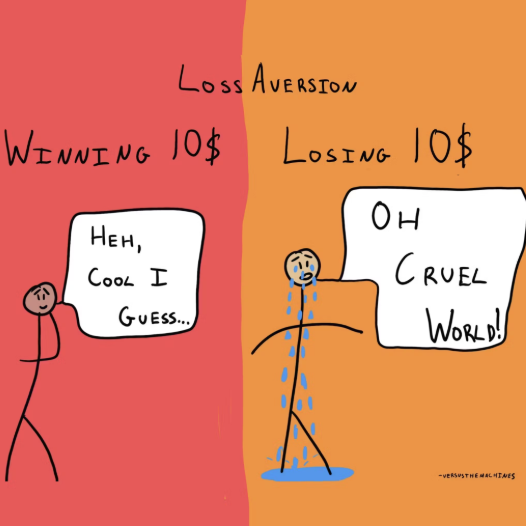
And of course, we all gamble for one reason: to win money. The idea of walking out richer than when we walked in is irresistible. But here's the catch — loss aversion.
Loss aversion is a cognitive bias where the emotional impact of a loss is felt more intensely than the joy of an equivalent gain.
- The Decision Lab [2]In plain terms, losing hurts more than winning feels good. You'd care far more about losing money at the casino than you would about winning the same amount. So when the odds are stacked in favour of the house, why are we even there? It's certainly not improving our lives.
So How Much Do Australians Gamble?
We collectively wagered over $240 billion — losing more than $30 billion to the house. That's an average of $1,500 per adult, the highest gambling loss rate on the planet. Around six in ten Australians gamble, and a third now do it online.
Words can't quite capture that scale — but a chart can, and this is the perfect example:
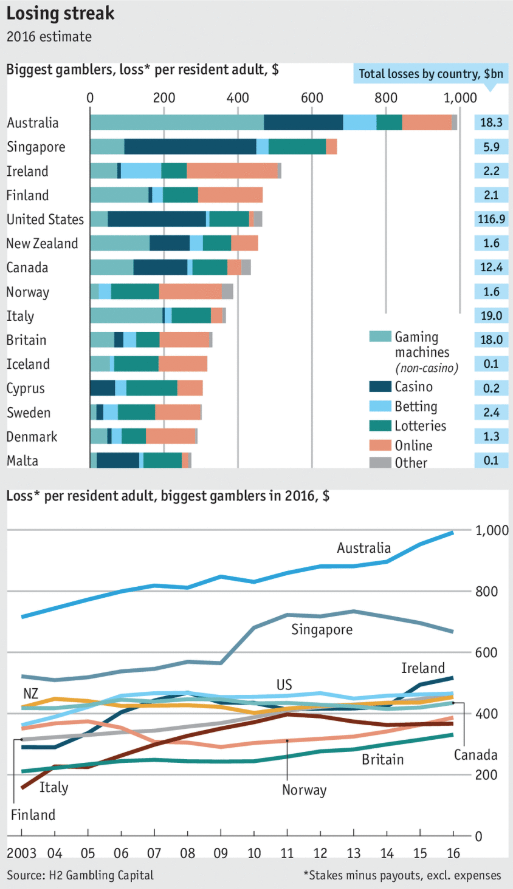
If I'm being honest, I found this chart on Reddit — because the actual source costs money, and I'm not about that life. Australia has the highest gambling loss per adult resident, according to a 2016 estimate. And honestly, that tracks. We know what Aussie culture is like. But is this something we're proud of? I think it's easy to look at our problems and shrug them off. Maybe we really are the world's worst gamblers. 😔
Pokies
Did you know states have a mandated rate of return? That means the government enforces a percentage payout per machine — and no, it's not in your favour. In Queensland, the rate of return for pokies sits between 85% and 92%. So for every $100 you put in, only $85 ever comes back out. Each state's different, and Victoria's the worst (no wonder there are always riots).
"Gaming machines are designed to earn revenue for venues. They're not designed for players to make money." [4]
Beyond the dopamine rush — the lights, colours, sounds, and social buzz — the game is rigged to keep you chasing those highs. People also chase their losses, thanks to the sunk cost fallacy: the idea that because you've already poured money into the machine, you're due a win. You're not. You're just digging a deeper hole.
If I Haven't Convinced You Yet…
Here are a few more hard facts:
- Less-educated people are statistically more likely to gamble.
- Vulnerable people get targeted because they're looking for a solution to financial challenges.
Need help with gambling? Free, professional, and confidential support - 24 hours a day, 7 days a week. Call 1800 858 858.
How to Play When It's Socially Unacceptable Not To
Sometimes you don't have a choice — a bucks night, a mate's 30th, some event where stepping into a casino is basically mandatory. But that doesn't mean you have to gamble. You can sip overpriced drinks and people-watch, or you can follow a few survival rules to make it through a couple of hours without going under financially.
First, take out the amount you're willing to lose, in cash before you even walk in. That's your budget, your limit, your line in the sand. Tell yourself you're not going back to the ATM — because you're not.
Next, know the odds. The whole place is designed to get you, but at least understand how each game works before you hand over your money. I've always been told roulette has the best odds in the casino — so start there.
Your goal isn't to make money; it's to stay in the game without going broke. Play small, play slow, and pick busy tables. You're here for fun, not profit — because if you throw everything on red and lose, the fun's over.
And finally, play with your friends. If you find yourself alone at a table, already in the negative, it's time to call it. Go home.
Taylor's Three Levers
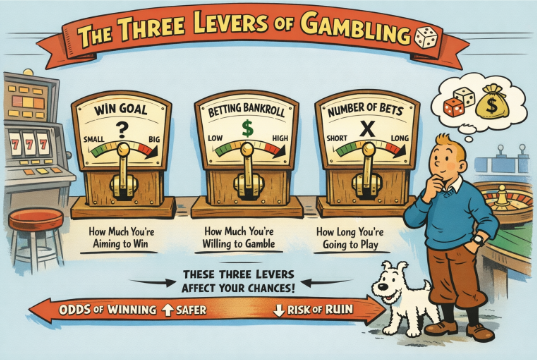
Whenever I walk into a casino, I picture three levers — or maybe bar charts — lined up in my head. Each one controls a different part of the gamble:
Those three levers shape everything. If I've got $1,000 and decide to only play for $5 wins, my odds of actually winning go up. It's not magic; it's math. The smaller the stakes, the better the odds — though let's be honest, that's rarely as thrilling. Still, I'd rather pull those levers with intention than chase luck blindfolded.
Your odds improve even more if you take your time with small, cautious bets instead of trying to win it all in one go. If you're curious, look up the Martingale System — it's a fascinating example of how this logic plays out.
Did I Make This Up?
I asked an AI whether I'd invented this idea or absorbed it from somewhere else. Turns out, it's a mash-up of a few known theories — Gambler's Ruin and Bankroll Management (or Risk of Ruin, depending on who you ask).
So no, I didn't pull it out of thin air. But I did frame it in a way that makes sense to me — three levers that interact, shaping how luck, risk, and time play together. It's my version of the math behind the madness.
📚 References
- How They Get You by Chris Kohler — Penguin Books Australia
- Loss aversion — The Decision Lab
- Reports | H2 Gambling Capital
- Gaming machines and gambling odds refresher course | Business Queensland
- Gambling | Department of Social Services